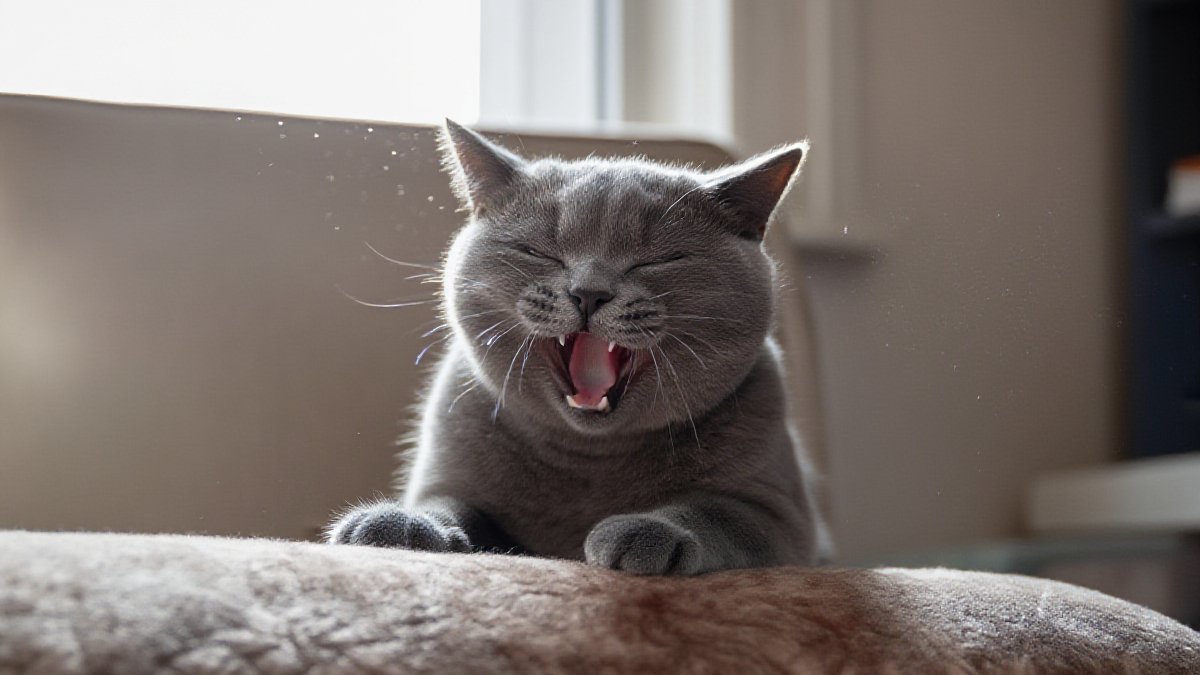
A cat sneeze is one of the most disarming things a pet owner can witness — a tiny whole-body event, ears back, and then business as usual. That is also why sneezing is so easy to misread in both directions. Owners dismiss three days of worsening sneezing as "dust," and they rush a single sneeze after a litter-box dig in for an emergency visit when it was just a nasal insult. The truth sits in the middle: sneezing is normal in bursts, abnormal as a trend, and the trend is what carries the medical information. Upper respiratory infections are among the single most common reasons a cat sees a vet in its first year of life, and in adult cats the same symptom can be the opening act of dental disease, a fungal infection, a foreign body, or a nasal tumor.
This guide separates the harmless sneeze from the developing problem: what a normal sneeze pattern looks like, the symptom combinations that define a feline upper respiratory infection (URI), the red-flag pairings that should move a same-day appointment to the front of the line, what home care genuinely helps, and how a vet visit actually unfolds — including one worked example of what that first appointment should look like.
First, the Harmless Kinds — and Why They Happen
Cats explore the world nose-first. Whisker-thin at the tip and packed with nerve endings, the feline nose takes a beating: litter dust, grooming dander pulled into the nostrils during a face wash, a sniff of last night's spice shelf, the pollen that rides in on an open-window afternoon. The resulting sneeze is a one-and-done clearing event. Vets describe a normal pattern by its shape: isolated, occasional, no other symptoms, cat bright-eyed and eating. If your cat sneezes a few times in one minute after digging in a freshly poured litter box and never does it again that day, you watched household physics, not illness.
The distinction worth internalizing is frequency versus pattern. Sprinkled sneezes across a week, with no runny eyes, no drop in appetite, and normal energy, fall in the "mention it at the next visit" bucket. Sneezing that clusters — multiple days in a row, or several sneezes every time the cat wakes — is no longer a clearing event. It is inflammation doing the sneezing, and inflammation has a cause.
Upper Respiratory Infections: The Usual Culprit by a Mile
When sneezing in a cat is genuine illness, the overwhelming majority of the time it is a feline upper respiratory infection — "cat cold" in everyday language. Two viruses cause the overwhelming majority: feline herpesvirus (FHV-1) and feline calicivirus. Herpesvirus in particular writes itself into the cat for life after infection; the virus goes dormant and re-emerges under stress, which is why owners so often report the sneezing started "right after we moved / got a new cat / the construction on our street." Calicivirus tends to come with mouth ulcers, and herpesvirus ruins eyes on the way through — the classic owner description is "sneezing with gunky eyes."
- Sneezing that clusters over hours-days, often crescendoing for the first 3–5 days.
- Clear, watery eye discharge — later thickening to cream or green as secondary bacteria move in.
- Nasal discharge going from clear to opaque — the color shift itself is not a diagnosis but tracks severity.
- Congestion you can hear: audible_stuffiness, snuffling, open-mouth breathing in bad cases (open-mouth breathing is always worth a same-day call).
- Fever, reduced appetite, lower energy — the "acting sick" layer. Unvaccinated kittens and newly adopted shelter-rescue cats are the highest-risk group.
Own a Veterinary Clinic?
Enjoyed this article? Our editorial team researches, writes, and publishes professional features just like this one about clinics across the US. Get your practice in front of thousands of cat owners searching for a vet in your city.
One sentence of reassurance, then one caution. Reassurance: in an adult vaccinated cat with no appetite change, most URIs run their course in 7–10 days, and vets intervene mostly with supportive care and secondary-bacteria management. Caution: the same virus pattern in a kitten, a senior cat, or a cat who stops eating becomes dangerous within days — cats will not eat what they cannot smell, and a cat who skips meals for three days is heading toward hepatic lipidosis, a liver disease that can be triggered by as little as two to three days of anorexia in an overweight cat.
The Red Flags: Stop Watching, Start Calling
Some sneezing presentations are not watch-and-wait situations:
- Open-mouth breathing or panting — cats do not physiologically pant the way dogs do; an open mouth in a cat is respiratory distress until proven otherwise. Same-day, ideally now.
- Kitten under six months with sneezing plus eye discharge — kittens decompensate fast; same-day visit.
- Not eating for more than 24 hours — whatever the cause, a cat off food is a clock running. The moment food is refused, this is no longer a "mild cold."
- Thick green or blood-tinged nasal discharge from ONE nostril — one-sided discharge changes the differential completely: foreign body (a grass blade), a tooth root abscess erupting into the nasal passage, or a tumor in older cats. This is an exam-not-a-phone-call situation.
- Swelling over the bridge of the nose, or a nose that was once a perfect triangle and is now asymmetric — supportive diagnostics are warranted.
- Sneezing blood (actual red flecks or drops) — trauma, foreign body, severe infection, clotting problem. Same-day.
- Sneezing plus pawing at the face or mouth, or a sudden preference for soft food — in middle-aged cats this pattern is frequently dental disease, specifically forodontic resorptive lesions or a tooth root abscess, both of which can sneeze when the root of an upper premolar breaches into the nasal cavity.
When It's Not an Infection: The Other Suspects Vets Rule Out
Chronic sneezing that does not follow the URI script gets a wider work-up, and it helps owners to know the shortlist your vet will be working through — because the order of the work-up is often exactly the order of likelihood.
| Suspect | Typical signal | How it gets confirmed |
|---|---|---|
| Herpesvirus flare (chronic carrier) | Same cat, same stress trigger, sneezing + conjunctivitis episodes that recur | Response to treatment plus history — the pattern IS the diagnosis |
| Dental disease / tooth root abscess | One-sided discharge, bad breath, preference for soft food, pawing at face | Dental exam under anesthesia; X-rays catch roots not visible in the mouth |
| Foreign body (grass blade, seed) | Sudden violent onset, violent head-shaking, one nostril | Rhinoscopy or nasal flush — often curative on the spot |
| Fungal infection (Cryptococcus in the Northeast, Aspergillus) | Chronic discharge unresponsive to antibiotics, sometimes a lump over the nose | Cytology/antigen testing — treat early; these can be serious |
| Nasal polyp | Younger cat, snoring, chronic congestion | Visualized under sedation; surgically removable |
| Nasal tumor | Older cat, progressive one-sided bleeding or obstruction, weight loss | Biopsy or imaging; prognosis depends heavily on stage |
The薰 practical takeaway from the table: your vet will care a great deal about three facts you hold — Which nostril? When did it start, and what changed in the home first? And has it already ignored one course of antibiotics? Those three answers split the six-row table above into one or two real candidates before any diagnostic spending happens.
Home Care That Actually Helps (and What Does Not)
For a vaccinated adult cat, bright-eyed, eating, sneezing with mild clear discharge, a 72-hour home protocol is reasonable and recommended before booking a non-urgent appointment:
- Steam the nose. Sit the cat in a closed bathroom while a hot shower runs, 10 minutes, twice a day — genuinely helps congestion and is free.
- Wipe the face with a warm damp cloth — especially crusty eyes. Some URI cats refuse food because crusted eyes and a blocked nose make the bowl approach unpleasant.
- Strong-smell the food. Warm up a couple of spoonfuls of pâté-style food (or plain cooked chicken) so the aroma carries. Cats eat with their noses first.
- A humidifier in the cat's main room helps dry-air winter congestion.
- Keep the stress load down. Herpes flares are stress-responsive — a calm room prevents the second round.
What the Vet Visit Looks Like When You Book It
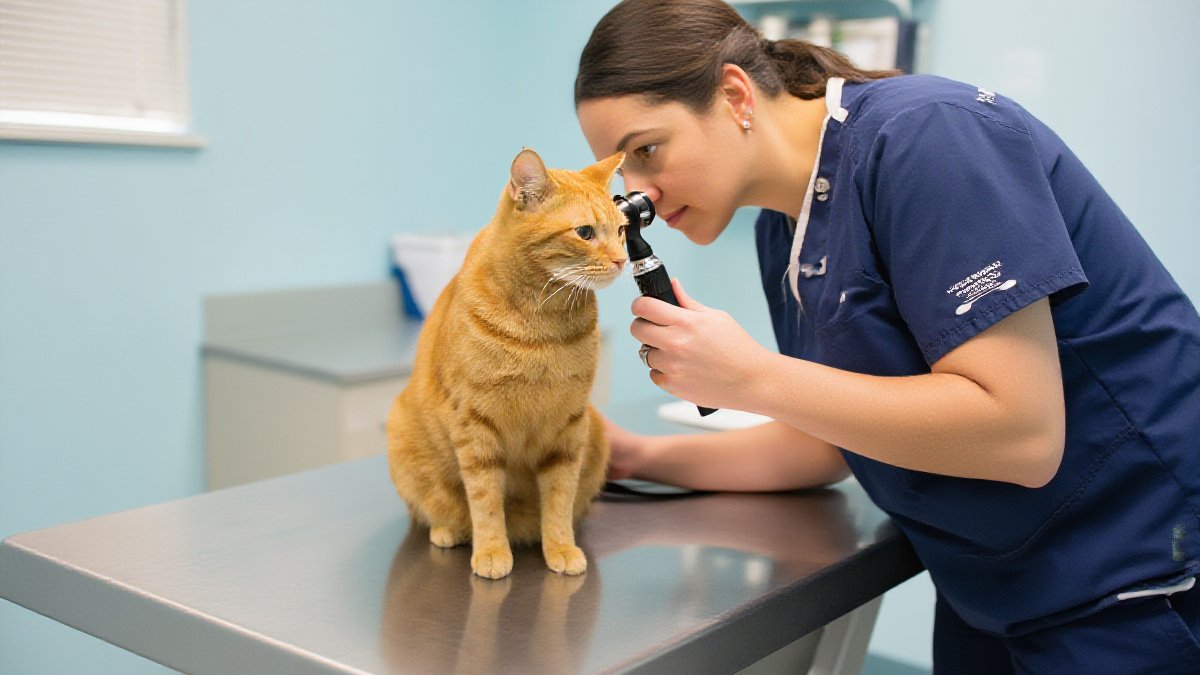
Expect four routine elements, not a mystery: a full physical exam with emphasis on the eyes, mouth (the dental-disease check most owners skip the significance of), and lymph nodes; an eye stain if the eyes are involved — fluorescein dye confirms a corneal ulcer, which herpesvirus causes in cats and which changes the eye treatment; a brief blood panel if the cat is a kitten, a senior, or systemically unwell; and a conversation about where the case sits between "viral URI, ride it out with support" and "needs work-up." Antibiotics are prescribed with intent — for secondary bacterial infection, not for the virus — and anti-herpals like famciclovir are reserved for severe flare-ups rather than every first visit.
If sneezing has been going on for weeks despite real treatment, or the discharge is one-sided, the referral tier is rhinoscopy and nasal imaging. Knowing that is coming lets owners budget for a two-stage process rather than expecting a single visit answer.
What This Looks Like in Practice: Bronx Animal Hospital / Bronx Vet Center, Bronx, NY
Because a URI visit rises or falls on the quality of that first exam conversation, it helps to see what a good version of it looks like in a real practice. Bronx Animal Hospital / Bronx Vet Center on Lurting Avenue in the Bronx, New York — carrying a 4.5-star average across some 54 owner reviews — is a full-service neighborhood hospital offering comprehensive physical exams across all life stages, senior wellness care, microchipping, behavioral counseling, and parasite prevention. Their published service list covers the exact pieces a sneezing-cat workup touches: wellness exams, senior screenings, and preventive care assessments. Reviews and phone interactions describe hands-on, unhurried exam-style visits from a practice the neighborhood has kept returning to — the sort of setting where a "is this just a cold or the start of something" question gets an actual answer instead of a rushed prescription.
Bronx Animal Hospital / Bronx Vet Center
3004 Lurting Ave, Bronx, NY, 10469
Phone: (718) 292-1770
⭐ 4.5 (54 reviews)
For a sneezing-cat owner specifically, the practical advantages are concrete: a full-service mixed practice means the corneal-stain test, the dental check, and the blood panel are all available under one roof instead of requiring a second referral trip; and a practice that offers senior wellness screening is one that has already built the habit of treating a seven-year-old "sneeze" as a signal, not a noise — which is exactly the judgment call the symptom demands in middle-aged and older cats.
Vaccination and Management: Why Some Cats Never Get Sick
The core URI vaccines (FHV-1 and calicivirus, part of the standard FVRCP series) do not always prevent infection — herpesvirus gets around them — but they reliably convert severe disease into mild disease, and they meaningfully reduce the shedding that spreads URI in multi-cat environments. In practical terms: a current-vaccine cat who meets the virus mostly sneezes for a weekend; an unvaccinated kitten who meets it can land in an oxygen-rich hospital bed. The vaccine is not perfect. It is still the single highest-leverage piece of sneeze prevention that exists.
- Keep the FVRCP series current — kitten series on schedule, adult boosters per your vet's interval.
- New-cat quarantine for two weeks before mixing with the household cats — shelter-intake URI is the classic introduction route.
- Reduce crowd-exposure for chronic carriers — boarding and multi-cat catteries are re-flare environments; some chronic-sneezer cats do better with at-home pet-sitter care instead.
- Wash hands and change clothes after handling a sneezing cat before touching the household cats — the virus rides on hands and surfaces for hours.
Questions Cat Owners Ask About Sneezing
Symptom-ledger neighbors of this one, in case they describe things you are also seeing: what chronic vomiting does and does not mean covers the frequency-based approach to sorting noise from disease, the full list of household plants toxic to cats covers the toxin angle that can masquerade as an infection, why indoor cats still need parasite prevention covers the preventive schedule that usually determines URI severity, and what actually makes cats lose weight covers the companion symptom that turns "a cold" into an internal-medicine work-up.
This article is editorial content produced by the CatVetFinder team. Clinic details are drawn from public listings and may change — always confirm hours and services with the clinic directly.