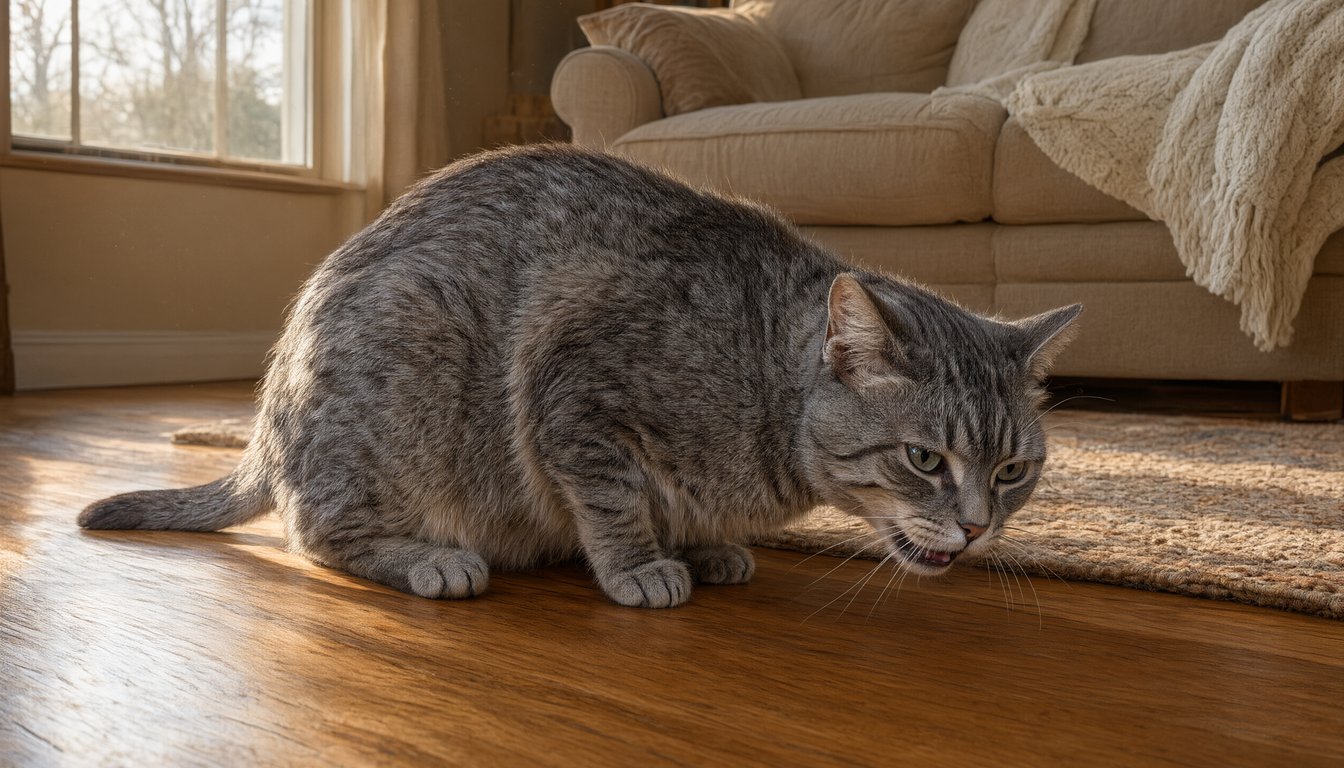
Almost every cat owner has stood over that sound — the low, gagging, from-deep-in-the-chest racket that ends either in a hairball on the rug or in nothing at all. And almost every owner has been told, by a well-meaning friend or an internet thread, that "cats just cough up hairballs, it's normal." That advice is quietly dangerous, because the two things it blends together are not the same event. A hairball is a stomach problem. A cough is a lung and airway problem. Cats produce hairballs constantly and only rarely bring them up; when a cat produces the retching sound and no hairball appears, a meaningful share of the time the cat was never trying to vomit at all — it was coughing, and coughing in a cat is one of the most under-recognized early signs of feline asthma, chronic bronchitis, and respiratory disease.
This guide gives you the practical skill of telling the two apart in real time: what each looks and sounds like, why the confusion is so common, the specific cough patterns that should not wait for a scheduled appointment, and what actually happens at the vet when a cough turns out to be asthma — including one worked example of what a good first visit looks like.
The Quick Anatomy: Two Different Pipe Systems
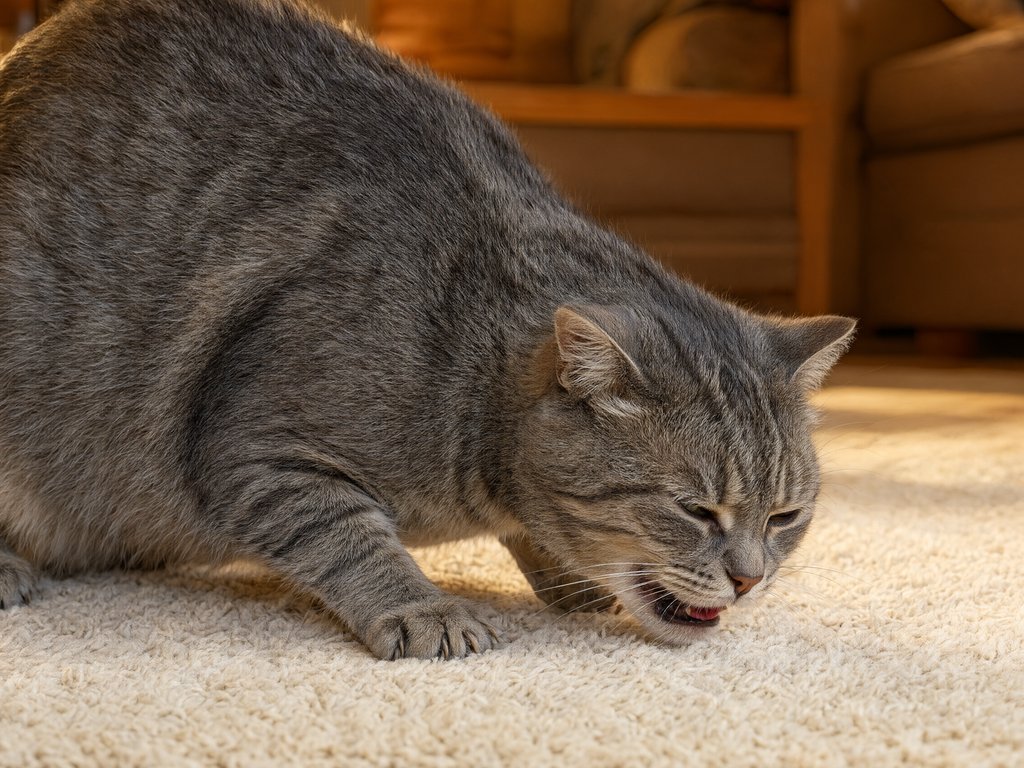
A hairball (trichobezoar) is wads of swallowed fur compacted in the stomach. When it comes up, the event is vomiting: the cat hunches, the abdomen heaves rhythmically, the head stays low, and the end product is a tubular mass of fur, usually with a slick coating of stomach fluid. The effort comes from the belly. A cough, by contrast, is generated by the airway — the throat, the windpipe, the bronchi, the lungs. The effort comes from the chest and neck: the cat drops into a crouch, stretches the neck straight out parallel to the floor, and makes a series of short, dry, honking or hacking expulsions with almost no abdominal heave. Nothing comes out, or just a little foam, because there was never anything in the stomach to bring up.
That posture difference is the single most useful clue you own. Neck stretched low and forward, crouched flat, dry honk, no product — that is a cough, every time. Head down over the floor, rhythmic belly heaves, product arriving — that is vomiting, and "hairball" is only one of the things a vomiting cat is doing.
| Clue | Hairball (vomiting) | Cough (airway) |
|---|---|---|
| Body posture | Hunched, head down, abdominal heaving | Crouched low, neck stretched straight out |
| Sound | Wet retching, gagging | Dry honking or hacking, "choking on a crumb" |
| Ends with | Tubular fur mass (sometimes just fluid) | Usually nothing, or a small amount of foam |
| Frequency pattern | Scattered, often after grooming | Episodes, often several in a row; can be daily |
| What it involves | Stomach | Throat, windpipe, bronchi, lungs |
Why This Distinction Matters More Than Owners Think
Feline asthma (allergic bronchitis) and chronic bronchitis are among the most common respiratory diseases in cats, and their classic owner description is, verbatim, "she keeps trying to bring up a hairball but nothing comes out." Asthmatic cats cough in episodes — often triggered by dust, litter, smoke, spring pollen, or plain exertion — and between episodes many look completely normal, which lets the problem hide for months or years behind the hairball excuse. Untreated, the airway inflammation remodels: the tubes stiffen and narrow, the episodes get longer, and an asthmatic cat can progress to a full respiratory crisis, open-mouth breathing, and an emergency hospital visit. Treated early, most asthmatic cats live ordinary lives for years. The difference between those two futures is very often just whether the cough got recognized as a cough.
Coughing has other causes too, and they map roughly to age: in a young adult, asthma and respiratory parasites (lungworm, heartworm — yes, indoor cats get heartworm) lead the list; in a senior cat, the list widens to include chronic bronchitis, fluid around the lungs, chest tumors, and heart disease. None of those get better because the owner bought a better hairball gel.
Own a Veterinary Clinic?
Enjoyed this article? Our editorial team researches, writes, and publishes professional features just like this one about clinics across the US. Get your practice in front of thousands of cat owners searching for a vet in your city.
Coughs That Should Not Wait for a Scheduled Appointment
- Open-mouth breathing, panting, or breathing with the belly rocking — cats do not normally pant. In a cat, an open mouth with a cough is airway distress. Same-day, ideally now.
- Coughing with blue or grey-tinged gums or tongue — oxygen emergency. Go immediately.
- Sudden violent coughing plus pawing at the mouth or gagging — possible choking or a foreign body in the throat.
- A new cough in a cat that is also losing weight, off food, or sleeping far more than usual — the systemic layer changes the urgency.
- Coughing with wheezing you can hear across the room, or episodes lasting more than a minute where the cat seems frightened.
- Any cough in a kitten or a senior cat — young and old cats decompensate fast, and their differentials are more serious.
- A cough that has happened three or more times in a week, even if the cat seems fine between episodes — this is the pattern that turns out to be asthma surprisingly often.
What the Vet Visit Actually Involves
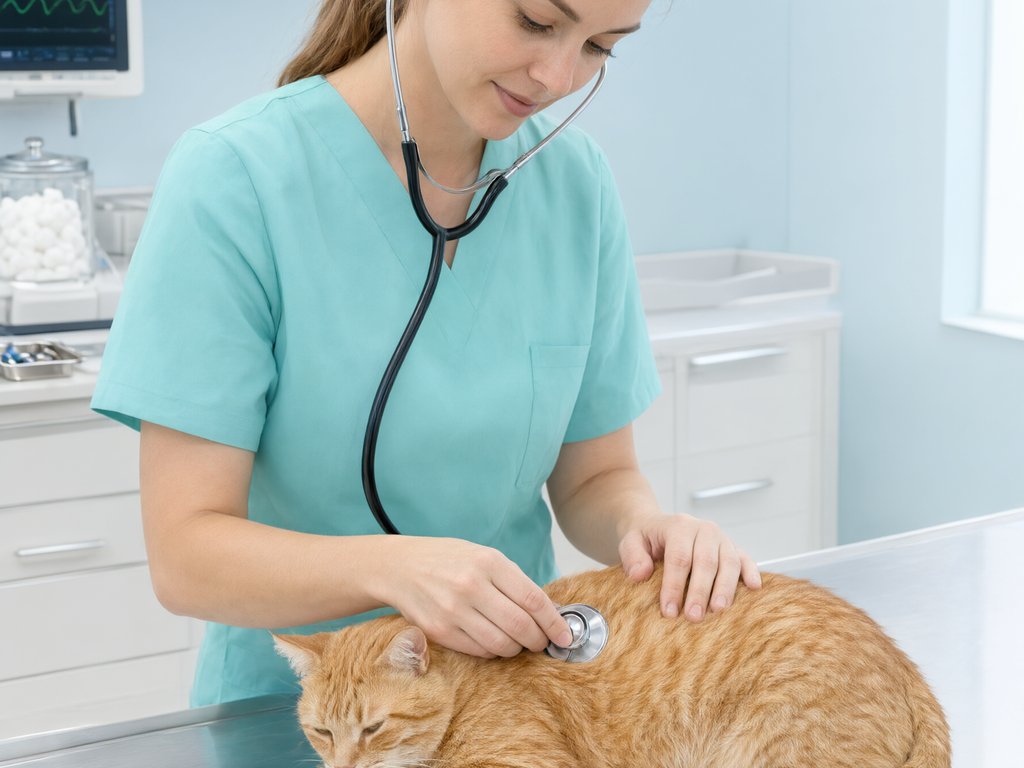
A coughing cat gets a focused work-up, and knowing the shape of it helps you prepare. First comes the physical exam with real attention to the chest — the vet listens to where the airway sounds sit, because wheezes heard high in the neck point to the windpipe while whistles heard through the stethoscope on the chest point to the lower airways. Then chest X-rays: this is the workhorse test, and an asthmatic chest has a recognizable look (a pattern vets call air-trapping and "donut bronchograms"). X-rays also comfortably rule in or out fluid, masses, and an enlarged heart in one visit. If the picture is ambiguous, the next tier is a fecal test for lungworms, a heartworm antibody/antigen panel, and in some cases a sedated airway wash (cytology) to identify the inflammatory cells directly.
Two practical tips that make the visit dramatically more useful: film a video of an actual episode on your phone before you go (episodes almost never happen on the exam table, and a video converts a vague story into a diagnosis), and note the timing — early-morning episodes point toward different causes than post-exercise or litter-box-adjacent episodes. If asthma is confirmed, treatment usually starts with a corticosteroid to break the inflammation, sometimes paired with a bronchodilator, and long-term control ranges from pill or liquid dosing to metered-dose inhalers delivered through a spacer mask made for cats — which sounds exotic and in practice becomes routine for many households.
Reducing Triggers While You Wait for the Appointment
- Switch dusty clay litter to a low-dust formula — litter dust is one of the most common cough triggers in indoor cats.
- No smoking, vaping, or aerosol sprays (hairspray, air fresheners, cleaning mists) in the cat's rooms.
- Run a HEPA air purifier in the room where the episodes cluster.
- Keep the grooming load down: brushing a long-haired cat daily genuinely reduces both hairballs and the swallowed-fur load that muddies the picture.
- Note the date, time, and duration of every episode for a week — the pattern log is diagnostic gold at the exam.
What This Looks Like in Practice: Dr. Joe Fuduric, Lima, OH
Because a coughing-cat visit rises or falls on a careful chest exam and a real conversation about episode patterns, it helps to see what a good version looks like in a working practice. Dr. Joe Fuduric on Shawnee Road in Lima, Ohio — holding a 4.8-star average across owner reviews — is a neighborhood veterinary practice serving Lima cat owners with comprehensive exams, diagnostics, and preventive care. It is exactly the kind of practice where the "I thought it was hairballs but nothing comes up" story gets taken seriously from the first visit: the exam, chest films, and parasite screening happen under one roof, and the follow-up plan gets built around the cat in front of the vet rather than a generic protocol. For owners in Allen County, that means a coughing cat can go from video-on-your-phone to a diagnosis and a treatment plan without a referral trip.
Dr. Joe Fuduric
845 Shawnee Rd, Lima, OH, 45805
Phone: (419) 223-7871
⭐ 4.8 (6 reviews)
One thing to ask any practice you call about a cough: whether chest radiographs are done in-house. A coughing cat worked up across two or three trips to different facilities loses weeks, and airway disease does not reward delay.
Questions Cat Owners Ask About Coughing
Related reading if you are sorting other confusing noises and outputs: what chronic vomiting means and when it stops being "just hairballs" covers the vomit-versus-disease line in depth, when diarrhea needs more than a bland diet handles the other end of the digestive tract, and why indoor cats still need parasite prevention explains the heartworm and lungworm reality behind one common cough cause.
This article is editorial content produced by the CatVetFinder team. Clinic details are drawn from public listings and may change — always confirm hours and services with the clinic directly.