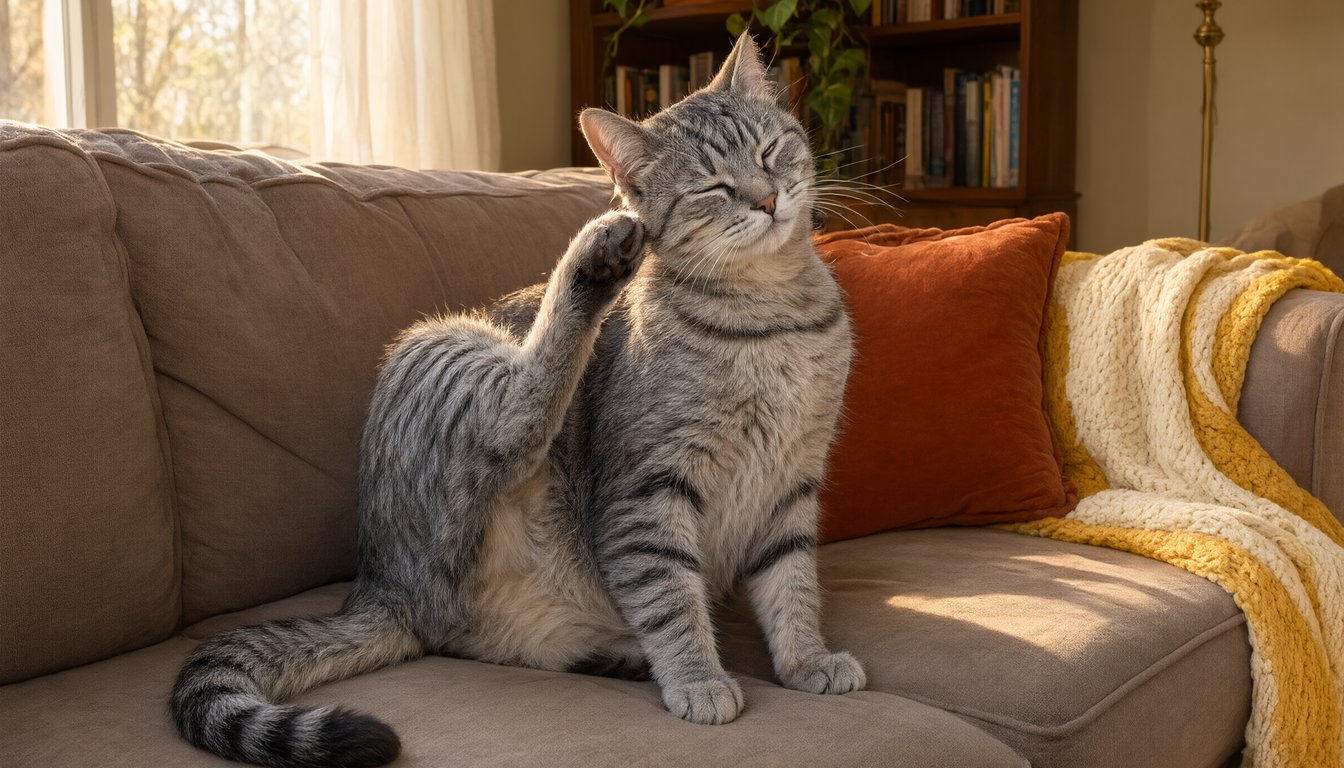
A cat that suddenly starts shaking its head like something is trapped in there — scratching at the ears hard enough to leave little scabs — has a short list of possible causes, and ear mites sit at the top of it. Otodectes cynotis, the common ear mite, is a pinhead-sized parasite that lives in the ear canal and feeds on skin debris and wax. It is absurdly contagious between cats (and sometimes picked up from dogs and rabbits), it is the single most common reason a kitten presents with "dirty" ears, and it produces an itch that owners describe as frantic. The catch is that mites are not the only thing that looks like this — yeast, bacterial infections, and grass awns produce the same head-shaking performance — and treating the wrong thing wastes weeks of the cat being uncomfortable.
This guide covers the whole arc: how to tell mites apart from the look-alikes, what actually happens at the vet visit (the exam takes minutes; the treatment is easier than it has ever been), what the options cost, what the cleaning and aftercare routine looks like at home, and how to stop the reinfestation loop that keeps some households dealing with mites twice a year.
The Signs: What Ear Mites Look Like Day to Day
Mites announce themselves through the cat's behavior before anything is visible. The classic sequence runs from occasional scratching to constant scratching, then head shaking that becomes a reflex the cat does the moment it wakes up. Alongside that, most cats develop a distinctive ear debris that owners reliably describe with two words: dark and dry.
- Frequent head shaking — often violent little shakes, several times an hour, not the single casual flick of a normal cat.
- Scratching the ears with back paws, sometimes hard enough to scratch the skin raw behind the ears or on the neck.
- Dark brown or black, crumbly debris deep in the ear canal — the famous "coffee grounds" appearance. It is dried blood and wax, not dirt.
- Rubbing the head against furniture or the floor, or holding one ear slightly flattened.
- In bad or long-running cases: a scratch wound near the ear, a reddened canal with an odor, or a swollen earflap (an aural hematoma) from a blood vessel ruptured by shaking.
- A new kitten from a shelter or multi-cat home with dirty ears within days of arrival — mites ride along more often than not.
Ear Mites vs. Ear Infection: Why the Guess Treats Fails
The reason guessing is a losing strategy is that the two most common "dirty ears" scenarios look similar from the outside but demand opposite approaches. A mite infestation is a parasite problem fixed by one or two parasite treatments. A yeast or bacterial otitis is an inflammation problem that usually follows an underlying allergy and needs a medicated ear cleaner — an antiparasitic does nothing for it. Between them sits ear mite mimicry by dried debris alone, and behind all of them, the foreign body: cats that go outdoors occasionally work plant material into their canals, and a grass awn produces sudden, one-sided, desperate head shaking that no cream will fix.
| Sign | More like mites | More like infection/other |
|---|---|---|
| Ear debris | Dry, black/brown, crumbly, coffee-grounds look | Moist, yellow-green, paste-like, often smelly |
| Which cats | Kittens, multi-cat homes, new arrivals | Any age, often cats with allergy history |
| Itch pattern | Both ears, intense, plus neck scratching | One ear more than the other, or pain-driven |
| Onset | Gradual, days to weeks | Sudden, or flares seasonally |
| At the vet | Mites visible under microscope in ear swab | Cytology shows yeast or bacteria |
That last row is the decisive one. The diagnosis at the clinic is not a feeling — it is a cotton swab of debris spread on a slide and viewed under the microscope, where live mites are unmistakable, moving white specks. It takes two minutes and settles the question in a single visit.
Treatment: What Actually Happens, From Both Ends
Ear mite treatment is one of the genuinely good news stories in cat medicine. A decade ago the protocol was weeks of daily mineral-oil cleaning plus repeated drops, and compliance was the failure point. Today the standard is a spot-on parasiticide applied to the skin at the back of the neck — the same family of products used for fleas — and for many cats, one dose plus a repeat in two to four weeks is the whole protocol. The reason for the repeat is the life cycle: eggs and immature mites survive the first treatment, and the second dose catches what hatched.

- Exam and swab — the vet confirms mites under the microscope and checks the eardrum before anything goes into the ear.
- Cleaning — debris is flushed or wiped out, because medication works poorly through a plug of wax. Heavy plugs may be cleaned over a second visit.
- Parasiticide — a spot-on product applied to the skin (topical selamectin-type or similar), dosed by weight. In some cases an ear drop formulation is used instead.
- Household treatment — every cat in the home gets treated on the same schedule, and dogs get covered too if mites have moved between species.
- Recheck — about three to four weeks later, to confirm the debris has resolved and no live mites remain.
Own a Veterinary Clinic?
Enjoyed this article? Our editorial team researches, writes, and publishes professional features just like this one about clinics across the US. Get your practice in front of thousands of cat owners searching for a vet in your city.
Cost-wise this is a modest visit: an exam fee (typically 50–80 dollars in most US markets), a swab and cytology if done (often 25–50), the parasiticide (roughly 15–40 per dose depending on the product), and sometimes a cleaner. A realistic all-in for a straightforward single-cat case lands somewhere between 100 and 200 dollars. What makes the number climb is the complication most owners have already dealt with by then: a scratched-raw neck, a hematoma needing draining, or a secondary infection — all of which are consequences of waiting weeks while the cat is frantic.
Home Care: The Week-By-Week Routine
Between doses and after the final one, the work at home is simple but easy to fumble. Three rules do most of it. First, do not put over-the-counter ear drops meant for dogs, or homemade remedies, into a cat's ear without a diagnosis — some OTC miticides are toxic to cats, and an undiagnosed ruptured eardrum turns any liquid into a middle-ear problem. Second, treat the household, not the cat: bedding that a mite-carrying cat sleeps on is part of the loop. Third, resist cleaning aggressively if the ears are painful — a painful canal usually means more than mites and deserves the vet's eyes, not deeper swabbing.

- Wash the cat's bedding and any shared blankets in hot water during the treatment window.
- Keep treated cats separated from untreated pets for the minutes the spot-on needs to dry.
- Follow the exact repeat date on the label or from the vet — the second dose is not optional; skipping it is the number one reason "the mites came back."
- Watch the ears for a week after the final dose. A few days of lighter debris is normal while old wax works its way out; black fresh debris or renewed frantic scratching is not.
- Check any new cat joining the household before it mixes with the resident cats — this is how mite-free homes stay mite-free.
What This Looks Like in Practice: Animal Emergency And Urgent Care Center
Animal Emergency And Urgent Care Center
103 N Powerline Rd, Deerfield Beach, FL, 33442
Phone: (954) 428-9888
⭐ 4.7 (225 reviews)
To make the visit concrete, here is one worked example. Animal Emergency And Urgent Care Center in Deerfield Beach, FL sits on 103 N Powerline Rd and runs a 4.7-star average across 225 reviews — and its name points at the reason a mite case might land there rather than at a daytime appointment: when the frantic scratching starts at 9 p.m. on a Sunday, or a kitten's ears have been getting worse all weekend, an urgent-care practice is the realistic option. A first urgent visit for ear mites looks the same as a daytime one in substance — swab, microscope, diagnosis, spot-on treatment, and an aftercare plan — with the trade-off that urgent-care pricing runs above a routine clinic visit in exchange for the hours. Their number is (954) 428-9888.
The practical takeaway from a practice like this one is sequencing. If the head shaking started this morning and the cat is otherwise eating, playing, and calm, a routine appointment within the next day or two is fine. If the shaking is violent and sudden in one ear, if there is blood in the debris, or if the earflap is ballooning into a soft swelling, that stops being a mite conversation and becomes a same-day one. owners who know which of the two situations they are in tend to spend less and resolve the problem faster.
Questions Cat Owners Ask About Ear Mites
Ear symptoms rarely travel alone — cats with mite-driven scratching sometimes show other signs worth a second look. Why a cat keeps sneezing covers the other common "new kitten brought something home" scenario, and indoor parasite prevention explains why the same spot-on products that kill mites also close the gap on fleas and heartworm. For the debris that is not mites, cat diarrhea and digestion problems takes the same "when to worry" approach to the gut.
This article is editorial content produced by the CatVetFinder team. Clinic details are drawn from public listings and may change — always confirm hours and services with the clinic directly.