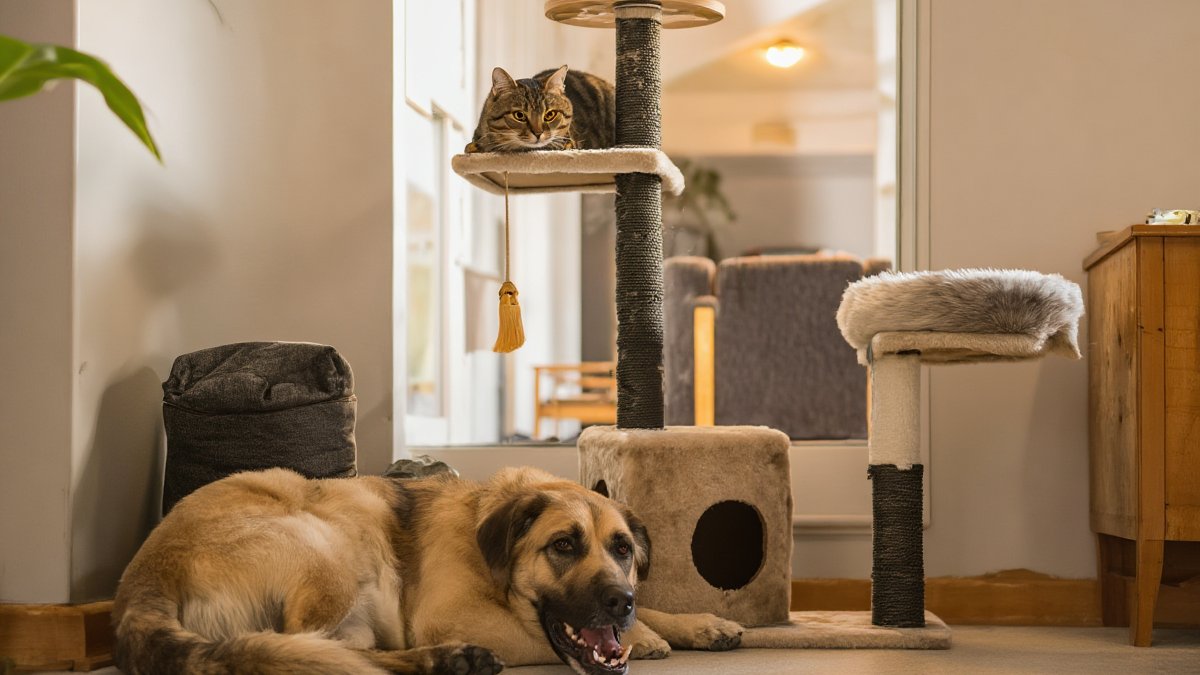
The question that brings most owners here is blunt: "Will my dog hurt my cat?" Sometimes it comes from a household adding a puppy to an established cat's kingdom; more often from a rescue dog whose history with cats is a line in an adoption file that nobody can vouch for. The honest answer is that outcomes are decided not by the species matchup but by how the first few weeks are run — a rushed face-to-face meeting between a prey-driven dog and a cornered cat is how one bad afternoon creates a war that lasts years.
The good news: the introduction process is boring by design. It is a slow ladder of scent, sound, sight, and finally supervised contact, and nearly every disaster story begins with skipping two rungs. Here is the full ladder, plus how to read the signals that tell you to go back one step.
The First 48 Hours: Two Rooms, One Closed Door
The cat gets one fully equipped room — litter, water, food, a hiding spot, a vertical perch — and the dog gets the rest of the house. Neither animal "meets" anything yet. What you are actually doing is letting each animal learn that the other exists as a smell. Feed both on their sides of the door, so the sound and scent of the other species becomes background noise attached to something good. Swap bedding between the rooms. Let the cat do the discovering at her own pace; a cat who spends day two sitting at the door crack is succeeding, not failing.
The Sight Introduction: A Gate, a Leash, and Short Sessions
Once both animals are eating calmly on opposite sides of the door for a few days, the gate goes up (or the door opens an inch with a block). The dog is on a loose leash, sitting or lying down; the cat is free to approach or not — the door is the dog's limit, never the cat's. Keep the first sessions under five minutes and end them before either animal gets tense. Feed treats on both sides, at a distance where the dog can disengage and look away on request. The disengagement is the skill you are building: a dog who can notice the cat and then choose to look back at you is a dog who is learning that the cat is a fact of the environment, not an event.
Repeat daily, gradually lengthening. The failure signs are specific: the dog fixating — a frozen stare, a low rigid body, silent stalking — or the cat refusing to approach for over a week while being otherwise healthy. Both mean slow down and return to the previous step for several more days. Neither means the pairing is doomed.

Own a Veterinary Clinic?
Enjoyed this article? Our editorial team researches, writes, and publishes professional features just like this one about clinics across the US. Get your practice in front of thousands of cat owners searching for a vet in your city.
Reading the Cat: Fear, Curiosity, and the Difference
A hiss at the gate is normal and useful — it is a boundary statement, not an attack, and it often teaches the dog exactly what it needed to learn. What worry looks like is different: a cat who hides without eating, stops using a litter box she has always used, or has flared pupils and flattened ears for hours after every session. Those are stress injuries forming, and the answer is more time in the base-camp room, not faster progress. Watch the dog too — play barks and play bows look chaotic but are loose-bodied, while a dog who lunges silently, whines at pitch while staring, or tries to get around the gate is not playing. Chase by a dog is not friendship in progress; even non-predatory chase trains both animals in a pattern that ends badly.
Supervised Room Time, and What "Success" Actually Looks Like
When the gate sessions run calm for a week or more, drop the gate in short supervised stretches with the dog leashed indoors. Manage the environment: the cat always has an elevated exit route, the dog has a mat and a job, and nobody gets to free-roam unsupervised until weeks of calm have accumulated. Success is unglamorous — two animals who can share a room without either one caring much. Many pairs never become cuddle partners, and that is a complete success. The disaster outcome is not "no cuddles"; it is a cat who lives her whole life compressed into one room because one meeting went wrong.

A Worked Example: Cummings Veterinary Hospital, Easton, PA
Behavior plans go further when someone has actually examined the cat, because a "scared of the dog" cat is sometimes a cat with a painful spine or an overactive thyroid — conditions that shrink every tolerance threshold. Cummings Veterinary Hospital: Daniels Natalie DVM on Church Road in Easton, Pennsylvania, is a five-star-rated practice where the pre-introduction exam and the behavior conversation happen in the same appointment: ruling out the physical drivers, discussing whether a feline pheromone diffuser or, in harder cases, short-term anti-anxiety medication is warranted, and pacing the plan to the animals in front of them rather than a generic timeline.
Cummings Veterinary Hospital: Daniels Natalie DVM
5111 Church Rd, Easton, PA, 18045
Phone: (610) 923-0393
⭐ 5.0
That matters because the two most common introduction failures — a medical problem masquerading as fear, and fear medicated by nothing but hope — are both caught by exactly this kind of visit.
When to Bring In a Professional
Three situations deserve help rather than more patience. First: any actual contact incident — the dog bit or pinned the cat, even once, without injury visible. Second: a cat who has stopped eating, stopped using the box, or is living full-time in hiding after two weeks of a proper plan. Third: a dog whose fixation does not improve with weeks of work, or who has any history that includes small animals. These are veterinary behaviorist or Fear-Free practice conversations, and they work much better in week two than in month six, after the pattern has hardened. There is no shame in the referral — introductions gone wrong are one of the most fixable problems in cat behavior, if the fix starts early.
Questions Cat Owners Ask About Cat-Dog Introductions
For the cat-only version of the same problem, see introducing a new cat to a resident cat — the scent-first ladder is the same. If the new cat is suddenly hiding after arrival, why cats hide suddenly separates normal adjustment from red flags, and the signs of flea allergy dermatitis and a full new-cat-owner checklist round out the first-month plan for a mixed-species household.
This article is editorial content produced by the CatVetFinder team. Clinic details are drawn from public listings and may change — always confirm hours and services with the clinic directly.