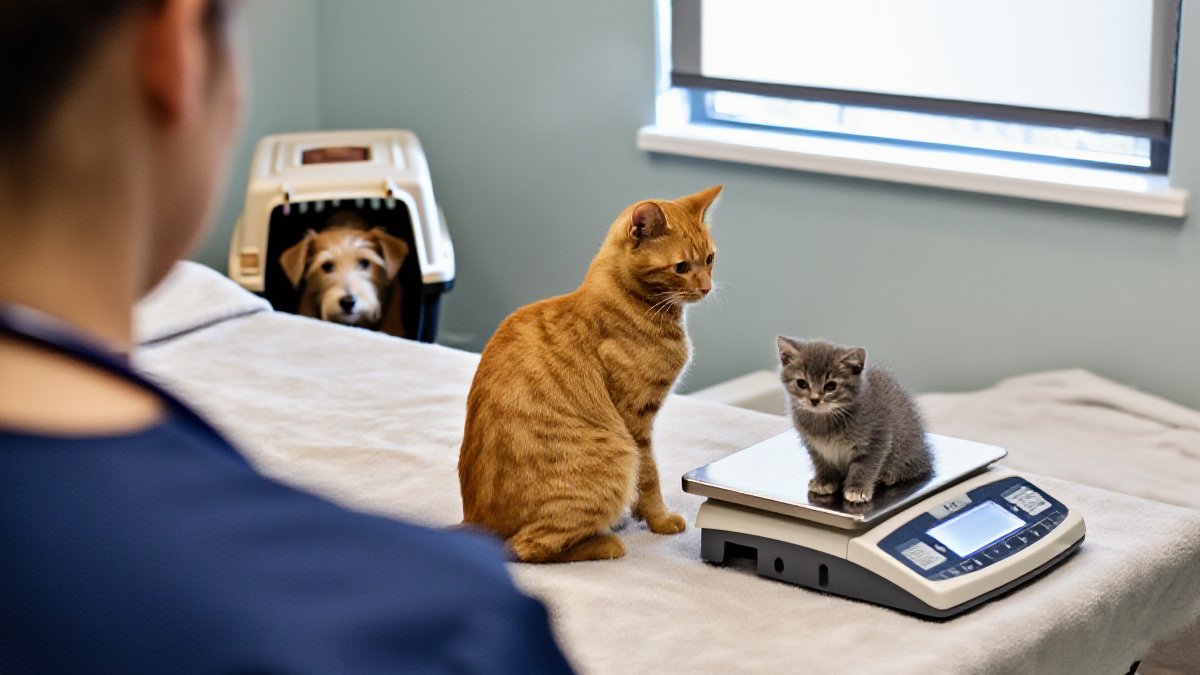
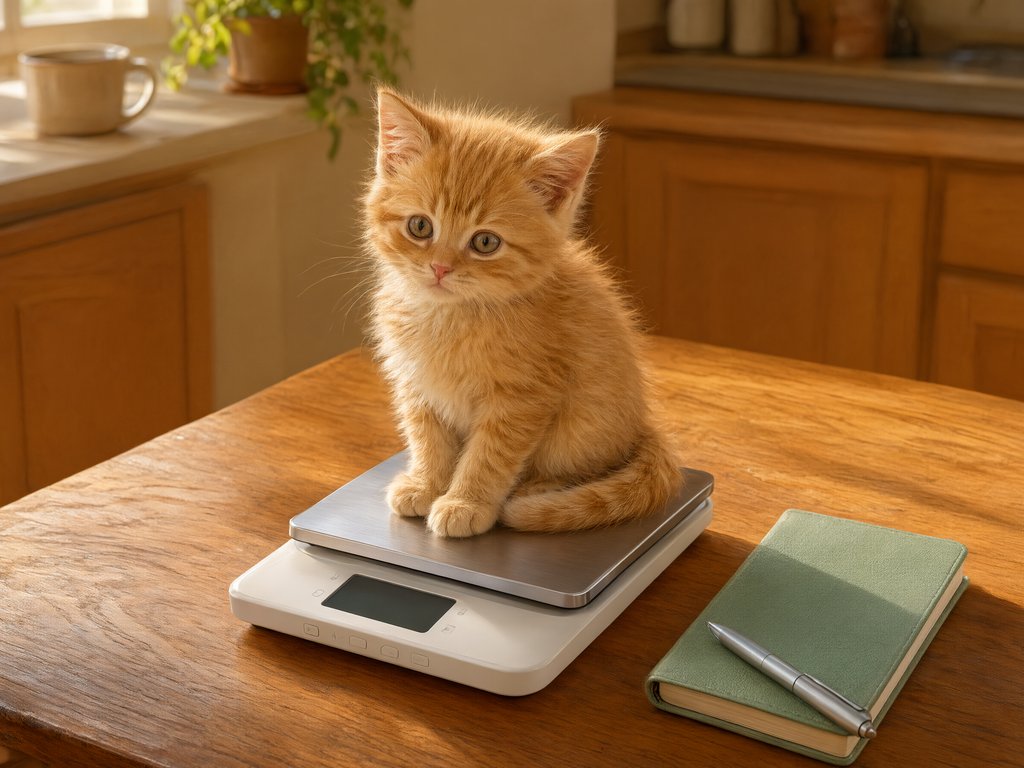
A kitchen scale is the most underused piece of kitten equipment there is. New owners budget for litter, food, toys, and a carrier, then discover a few weeks in that the single number telling them whether everything else is going right is the one they never thought to track: weight. Kittens grow fast, and they grow on a schedule that is remarkably predictable — which is good news, because any deviation from that schedule is one of the earliest warning signals in all of pediatrics. A kitten who stops gaining is sick long before she looks sick.
This guide walks through what the scale should be doing from the first day you bring a kitten home through the first birthday, week by week and gram by gram. It also covers the other side of the ledger: what it means when growth stalls, the usual suspects behind a kitten who is not gaining, and what a proper growth check at a wellness visit actually involves — using a real small-town practice as the worked example.
The Golden Rule: Roughly Half an Ounce a Day
Before any chart, memorize one rule that works whether your kitten was born on your couch or came home from a shelter at five weeks: a healthy kitten gains roughly 10 to 15 grams per day — about half an ounce — every single day, from birth until about four to five months of age. That is the number shelter medicine programs and neonatal rescues live by, and it beats any breed chart for everyday use because it does not care about ancestry. A bottle-fed orphan and a barn kitten both put on roughly the same daily weight if they are thriving.
Birth weight runs between 85 and 110 grams — about the weight of a chicken egg. From there, the expectation is simple: the kitten should weigh roughly double her birth weight by two weeks, and should never post a weighed day with zero gain or a loss. One flat day happens; two flat days in a row, or any actual loss after the first 24 hours, is a call to the vet, not a wait-and-see.
Own a Veterinary Clinic?
Enjoyed this article? Our editorial team researches, writes, and publishes professional features just like this one about clinics across the US. Get your practice in front of thousands of cat owners searching for a vet in your city.
A Week-by-Week Growth Timeline
Weights vary by individual, breed, and litter size, but the shape of the curve is consistent. Treat these as ranges with the daily-gain rule layered on top, not as pass/fail targets:
- Birth to 1 week: 85–150 grams. Eyes stay shut; the job is eating and sleeping. Daily gain of 10–15 g matters more than any single reading.
- 2 weeks: roughly double birth weight (175–250 g). Eyes open around day 7–14. This is also when a kitten who was never going to thrive usually announces it.
- 3–4 weeks: 250–400 g. Wobbling, starting to explore, beginning the transition from milk to gruel. Weigh every 2–3 days during weaning — appetite hiccups show up on the scale before they show up anywhere else.
- 5–8 weeks: 400–900 g. The heaviest growth-per-day stretch of kittenhood. Fully weaned by 8 weeks, and the traditional adoption window opens.
- 3–4 months: 1.5–2.5 kg (about 3.5–5.5 lb). Growth looks less dramatic because the kitten is stretching it over a longer frame — but daily gain should still be steady.
- 5–6 months: 2.5–3.5 kg. Adult teeth arrive; spay/neuter often happens in this window. Growth continues, just slower.
- 12 months: adult frame reached for most cats — 3.5–5.5 kg for average-sized cats, well past that for Maine Coons and other large breeds, who keep filling out until age 3–5.
When Growth Stalls: The Usual Suspects
A kitten who is not gaining is not a slow grower. Kittens do not have a "petite" phase — they have a list of reasons the scale stopped moving, and the list is worth knowing because the fixable causes outnumber the scary ones:
- Parasites. Roundworms and coccidia are the number one cause of failed weight gain in kittens and are cheap to treat — but the dose depends on weight, which is one more reason weigh-ins and deworming live at the same appointment.
- Not enough calories. Bottle-fed kittens are underfed constantly, usually because the nipple flow is wrong or the schedule drifted. A hungry neonate cries constantly and crawls with a belly that never rounds; a full one sleeps in a milk coma.
- Diarrhea or vomiting. Fluid loss erases gain overnight and dehydrates a small animal with almost no reserve. This pairs with weight stalling, and both together are urgent.
- Congenital or infectious disease. Fading kitten syndrome, congenital heart defects, and panleukopenia all present as a kitten who was gaining and stopped. These need a vet, not a forum.
- Dental or mouth pain in the weaning window. A sore mouth makes a kitten refuse kibble while still acting interested — check the gums, and soften the food.
The arithmetic that matters: a 400-gram kitten who skips two days of gain has lost roughly a week of progress relative to her curve, and a 400-gram kitten can dehydrate into real danger inside a day. Small bodies have no margin. This is why every rescue protocol treats weight as a vital sign, charted as deliberately as temperature.
What This Looks Like in Practice: Knight Daniele S DVM, Alpena, MI
Kitten wellness care does not require a big-city specialty hospital — it requires a vet who weighs, doses, and charts carefully, and that is exactly what a small-town solo practice does all day. Knight Daniele S DVM on M-32 in Alpena, Michigan holds a perfect rating from the owners who have reviewed the practice, and runs the kind of schedule small rural clinics are built around: Monday through Friday 8 a.m. to 6 p.m., Saturday mornings 10 to 1, closed Sundays. For a new kitten owner in the Alpena area, a growth-check visit is a straightforward stop — a weigh-in against the visit history, a fecal test for the parasites that stall growth most often, and weight-based dosing for dewormer and the kitten vaccination timeline that runs alongside it.
Knight Daniele S DVM
3463 M-32, Alpena, MI, 49707
Phone: (989) 356-4880
⭐ 5.0 (2 reviews)
The practical advantage of establishing your kitten at one practice early is that the growth curve stops living in your notebook and starts living in the chart. Six months of weights recorded by the same clinic, at the same scale, turns "is she about the right size?" into a plotted line the vet can read at a glance — and it makes the 12-month adult weigh-in the moment the whole kittenhood record pays off.
The Overweight Kitten Nobody Talks About
Every guide worries about kittens who are not gaining enough, and almost none mention the opposite problem, which shows up at month five or six: the kitten on track to be a heavy adult. Free-feeding dry food through the rapid-growth phase is fine for a genuinely growing kitten, but somewhere around spay/neuter the calorie requirement drops sharply while the bowl stays full. The habit of leaving food down all day, established in kittenhood, is how a five-month streak of perfect growth ends in an adult cat who needs a weight-loss plan. The transition that works: around 5–6 months, shift to measured meals, keep watching the scale weekly, and expect the curve to flatten on purpose — slower gain toward the adult frame is normal after altering, not a sign something is wrong. Our guide to indoor cat weight loss covers the adult side of that equation.
Questions Cat Owners Ask About Kitten Growth
If you are in the middle of raising a bottle baby or a newly adopted eight-week-old, a few of our other guides cover the same stretch of life from different angles: the new cat owner checklist for the first-week setup, the kitten vaccination timeline for the shot schedule that runs alongside every weigh-in, and what diarrhea in cats means and when to worry for the symptom that most often interrupts growth.
This article is editorial content produced by the CatVetFinder team. Clinic details are drawn from public listings and may change — always confirm hours and services with the clinic directly.