Owners use "UTI" as shorthand for nearly every litter-box problem, and vets hear it daily: "I think he has a urinary tract infection." Sometimes that is right. But the two conditions owners most often confuse — a true bacterial UTI and a urethral blockage — are not just different diseases. They sit at opposite ends of the urgency scale. One is uncomfortable and needs an appointment this week; the other can kill a cat within 24 to 48 hours and needs an emergency clinic now.
The confusion is understandable because the visible symptoms overlap: trips to the litter box, straining, little or no urine produced, licking at the rear end. This guide separates the two by what each one is, who gets it, how the clock differs, and what the veterinary workup looks like — because the single most valuable skill a cat owner can build here is knowing which of the two possibilities is in front of them.
The 30-Second Version
| Question | UTI (bacterial infection) | Urethral blockage |
|---|---|---|
| Who typically gets it | Female cats, any age | Male cats, most often young to middle-aged |
| Urine produced | Small amounts, frequently; sometimes bloody | Little to none, despite repeated straining |
| Pain level | Uncomfortable, urgent-feeling | Painful, worsening rapidly |
| Urgency | Vet appointment within a day or two | Emergency — same hour |
| Other signs | Accidents outside the box, strong-smelling urine | Vomiting, hiding, crying, lethargy, a tense hard belly |
One caveat before anything else: if you are not sure which you are looking at, treat it as the dangerous one. A blocked cat can die of potassium buildup and cardiac arrest within a day or two of the plug forming, and there is no safe "wait and see" for a male cat straining with no output.
What a True UTI Is — and How Rare It Actually Is
Here is the part that surprises owners: bacterial urinary tract infections are uncommon in young adult cats. The vast majority of straining, bloody, frequent-urination episodes in cats under ten are not infections at all — they are feline idiopathic cystitis (FIC), a stress-linked inflammation of the bladder wall that produces identical symptoms with no bacteria present. Studies of young cats presenting with urinary signs routinely find infection rates in the low single digits. True UTIs become more common in cats over ten, especially those with kidney disease or diabetes, which is why a cat with urinary signs and no prior history usually does not get antibiotics first — she gets urine testing.
The diagnostic gold standard is a urinalysis on a sample collected by needle from the bladder (cystocentesis), sometimes followed by a culture. That tells the vet whether bacteria are actually present, whether crystals are, and how concentrated the urine is. Treating "UTI" blind — antibiotics without a culture — is how cats get repeated courses of medication that never touched the real problem.
What a Blockage Is and Why the Clock Matters
A urethral blockage is a physical obstruction — usually a plug of crystals, mucus, and small stones — lodged in the urethra, the narrow tube that carries urine out. The male urethra is far narrower than the female, which is why blockage is overwhelmingly a male-cat problem, and why unneutered males with narrow urethras are at extra risk. Once the plug forms, urine backs up. The bladder becomes painful and firm, then potassium that should be leaving the body stays in the blood, and elevated potassium disrupts the heart rhythm. Untreated, a blocked cat typically dies within one to three days.
The progression has a shape owners can learn: first the cat strains repeatedly with drips or nothing; then he stops making trips, becomes lethargic, may vomit, cries when lifted near the belly, and hides. By the vomiting-and-hiding stage, the emergency window is already open. The treatment is sedation and passing a urinary catheter to remove the plug, followed by intravenous fluids and a hospital stay to flush the system and monitor potassium. Some cats block repeatedly and eventually need a surgical widening of the urethra — a decision made after, never instead of, the emergency unblocking.
Reading the Litter Box: The Signs, Side by Side
- Frequent small pees, possibly pink-tinged, cat otherwise eating and behaving normally → inflammation (FIC) or, less often, infection. Call the vet for an appointment.
- Repeated straining postures with no urine at all, especially a male cat → possible blockage. This is an emergency now, day or night.
- Straining plus crying, hiding, vomiting, or a belly that feels hard and tense like a grapefruit → blockage with rising toxin levels. Drive; do not wait for a callback.
- Peeing in unusual places — tubs, laundry, beds — with volume present → urgency or discomfort, but urine is moving. Appointment-level, not ER-level, unless the cat is male and then stops producing urine.
- Any cat producing no urine for 24 hours, regardless of sex → emergency, full stop.
What This Looks Like in Practice: Breckenridge Veterinary, Novi, MI
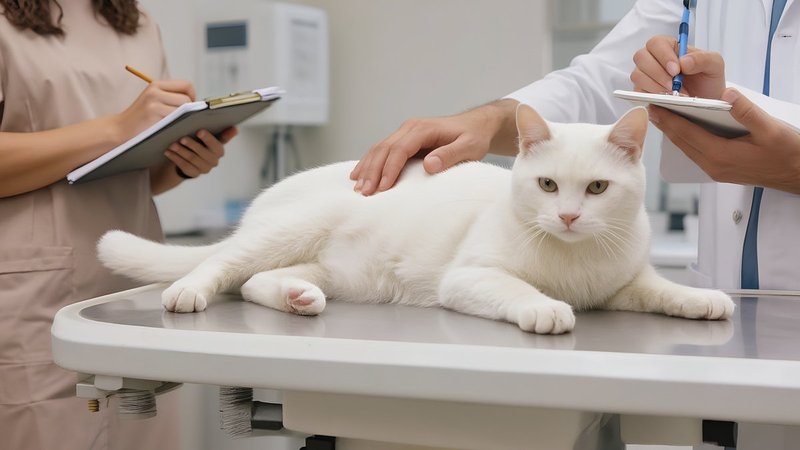
The diagnostic sequence above is exactly how a well-run general practice handles a urinary presentation. In Novi, Michigan, Breckenridge Veterinary on Novi Road — a 4.7-star practice with a solid review base — is the kind of clinic where a straining cat gets a urinalysis the same day rather than a guess-and-prescribe. The vet collects the sample, checks for crystals and blood, palpates the bladder, and — critically for male cats — knows to send the case to an emergency hospital immediately if the bladder is firm and non-productive. Owners in metro Detroit can also compare the full cat vets in Novi, MI listing.
Breckenridge Veterinary
21524 Novi Rd, Novi, MI, 48375
Phone: (248) 791-2387
⭐ 4.7 (189 reviews)
After the Diagnosis: Prevention for Both Conditions
The good news is that the prevention playbook overlaps almost completely, whether the diagnosis was cystitis, crystals, or a blockage. More water in, more urine out: wet food as the dietary base, water fountains or multiple fresh stations, and a prescription urinary diet when crystals were involved. For FIC specifically, stress reduction counts as medical treatment — stable routines, enough litter boxes for the household (the usual formula is one per cat plus one), and environmental enrichment all measurably reduce recurrence. Weight management matters too: overweight indoor cats have higher rates of both urinary inflammation and blockage.
Own a Veterinary Clinic?
Enjoyed this article? Our editorial team researches, writes, and publishes professional features just like this one about clinics across the US. Get your practice in front of thousands of cat owners searching for a vet in your city.
The habit to build is a two-question reflex whenever a litter-box problem appears: is urine coming out, and is the cat a male? Urine moving, cat comfortable — call for an appointment. No urine, or a male cat straining with growing distress — go now. For the full early-warning list specific to obstruction, male cat straining to urinate covers it in depth, and blood in cat urine walks through what hematuria does and does not mean.
This article is editorial content produced by the CatVetFinder team. Clinic details are drawn from public listings and may change — always confirm hours and services with the clinic directly.